
![What is AEO (Answer Engine Optimization)? A Complete Guide [2026]](https://seoinspectorhub.com/blog/wp-content/uploads/2026/06/Answer-Engine-Optimization-1200x630.png)
More than half of all Google searches in 2026 end without a single click.
- What is AEO (Answer Engine Optimization)?
- AEO vs SEO vs GEO: What is the difference?
- Why AEO matters more than ever in 2026
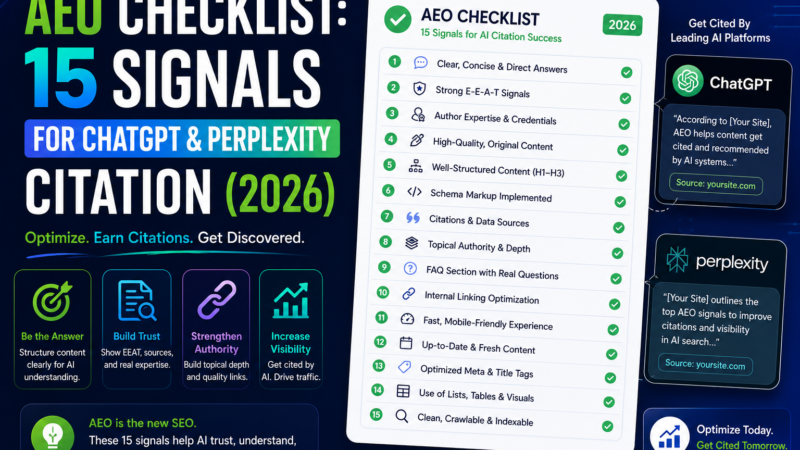
- How answer engines decide what to cite (the 5 core AEO signals)
- How to check your AEO score (free, no signup)
- AEO optimisation checklist for 2026
- Frequently Asked Questions
- Conclusion
Not because people didn’t find what they wanted but because an AI answered the question before they ever reached a website. ChatGPT. Perplexity. Google AI Overviews. Bing Copilot. These are not the future of search. They are search, right now.
Traditional SEO gets you a blue link on page one. AEO full form is Answer Engine Optimization gets you the answer itself. If your content is not structured for answer engines, you are invisible to a growing share of your audience, even if you rank on page one.
This guide explains exactly what AEO is, why it is the most important new SEO discipline of 2026, and the concrete steps you can take today starting with checking your own AEO score for free.
What is AEO (Answer Engine Optimization)?
AEO (Answer Engine Optimization) is the practice of structuring your website content so that AI-powered answer engines including ChatGPT, Google AI Overviews, Perplexity, and Bing Copilot select it as a direct, cited answer to a user’s question.
Unlike traditional SEO, where success means a click to your website, AEO success means your content becomes the response. The AI reads your page, extracts the answer, and delivers it to the user with your brand cited as the source.
This matters because hundreds of millions of people now phrase their searches as questions directed at AI, not keywords typed into a search box. “What is the best free white label SEO audit tool?” is no longer a Google query. It is a prompt. And whoever built the most authoritative, clearly structured answer to that question gets cited, not whoever paid the most for backlinks.
AEO is not a trend. It is a structural shift in how information is consumed online.
AEO vs SEO vs GEO: What is the difference?
These three disciplines work together and are often confused. Here is a clear breakdown:
| SEO | AEO | GEO | |
|---|---|---|---|
| Full name | Search Engine Optimization | Answer Engine Optimization | Generative Engine Optimization |
| Goal | Rank in blue links | Become the cited answer | Get cited unprompted by LLMs |
| Optimises for | Google’s ranking algorithm | AI assistants and featured snippets | Language models (ChatGPT, Claude, Gemini) |
| Success signal | Click-through rate | AI citation / snippet selection | Brand mentions in AI-generated content |
| Key techniques | Backlinks, on-page keywords | FAQ schema, question-based headings, direct-answer paragraphs | Entity authority, cross-web presence, content depth |
You need all three in 2026. SEO gets you traffic from people who still click. AEO gets you cited in AI search results. GEO gets AI models to recommend your brand without being asked. If you want the deeper picture on the third one, we cover it in full in what GEO actually is and how to optimise for it, and if you’re trying to figure out which of the three to prioritise first for your own site, this breakdown walks through exactly that.
Want the full side-by-side breakdown of goals, platforms, and techniques for all three? See the comparison table on our AI Search Optimization guide.
Why AEO matters more than ever in 2026
Answer engines have taken over daily search behaviour
ChatGPT crossed 300 million weekly active users in early 2026. Perplexity processes over 100 million queries per day. Google’s AI Overviews now appear on the majority of informational searches, the exact searches that used to drive blog traffic.
When someone asks an AI assistant “how do I check my AEO score?”, the AI does not return ten links. It returns one answer, with one or two cited sources. Being one of those sources is exponentially more valuable than being link number seven on page one.
Zero-click searches are accelerating
Research published by SparkToro in late 2025 found that over 58% of Google searches in the US and EU now result in zero clicks. That number has climbed every year since 2020, and with AI Overviews expanding, it will keep climbing.
If your content is not structured to be selected as the answer, the impression counts for nothing. You show up. Nobody arrives.
Most websites are not AEO-optimised yet
This is the genuine opportunity. Unlike traditional SEO, where page one is dominated by domains with thousands of backlinks and decade-old authority, AEO selection depends heavily on content structure. A newer website with clear, well-structured answers, proper FAQ schema, and question-based headings can outperform larger competitors in AI citations, right now.
The early-mover advantage in AEO is real and it is closing. Sites that act in 2026 will own their topics in AI answers for years.
How answer engines decide what to cite (the 5 core AEO signals)
Understanding what AI tools look for is the foundation of AEO. Based on our analysis of thousands of sites audited through SEO Inspector Hub’s AEO checker, these are the signals that matter most.
1. Direct-answer paragraphs immediately below headings
Answer engines scan for pages that answer a question in the first two sentences after the heading. This is called the inverted pyramid style put the conclusion first, then elaborate. A heading that says “What is Core Web Vitals?” followed by a 400-word preamble before the actual definition will almost never be cited. A heading followed by a crisp 50-word definition always has a chance.
The rule: Every H2 and H3 on your page should be followed immediately by a paragraph that fully answers the question it poses, in 40–80 words, before any further elaboration.
2. FAQ schema markup (structured data)
FAQ schema is JSON-LD code that tells search engines and AI crawlers that your content is a question-and-answer pair. It is the single highest-impact technical change most websites can make for AEO, and it takes less than an hour to implement.
Google’s documentation confirms that FAQ schema is eligible for rich results in both traditional search and AI Overviews. Perplexity and Bing Copilot also prioritise schema-marked content when selecting citations.
Example of correct FAQ schema structure:
json
{
  "@context": "https://schema.org",
  "@type": "FAQPage",
  "mainEntity": [{
    "@type": "Question",
    "name": "What is an AEO checker?",
    "acceptedAnswer": {
      "@type": "Answer",
      "text": "An AEO checker is a tool that analyses your website and scores how well it is optimised for answer engines like ChatGPT, Perplexity, and Google AI Overviews. It checks for FAQ schema, question-based headings, direct-answer content, and other signals AI tools use to decide what to cite."
    }
  }]
}
Add this to every page with a FAQ section. If you are unsure whether your existing schema is valid, run a free site audit at SEO Inspector Hub. It checks schema validity as part of the 60+ point audit.
3. Question-based headings (H2 and H3)
AI answer engines parse your heading structure to understand what questions your page covers. Headings formatted as questions “What is AEO?”, “How does answer engine optimization work?”, “Why is AEO important in 2026?” are far more likely to be matched to a user’s query than generic keyword headings like “AEO Overview” or “Benefits of AEO”.
Rewrite your top five pages so that every major section heading is phrased as the question your reader is actually asking.
4. Entity authority and E-E-A-T signals
Google’s helpful content system and AI citation algorithms both heavily weight E-E-A-T: Experience, Expertise, Authoritativeness, and Trustworthiness. This is not just a ranking factor, it determines whether an AI model treats your content as a trustworthy source worth citing.
Practical E-E-A-T signals that directly improve AEO performance:
- Experience: Include first-person observations, original data, and real case studies. “We audited 10,000 websites and found…” is an experience signal. Paraphrased information from other sources is not.
- Expertise: Author bios with verifiable credentials on every article. Link the author to a real LinkedIn profile or published work.
- Authoritativeness: Mentions of your brand on other websites, even without a link. Submit to tool directories, get listed in roundups, publish guest content on industry sites.
- Trustworthiness: HTTPS, clear About and Contact pages, privacy policy, and no misleading claims anywhere on the site.
For GEO specifically getting AI models to cite you unprompted entity authority is the dominant signal. If your brand appears consistently across the web (directories, forums, citations in articles), language models begin to associate your brand with your topic and recommend it in relevant conversations.
5. Page speed and technical health
A slow, technically broken page will not be crawled or cited by AI systems reliably. Core Web Vitals matter for AEO for the same reason they matter for SEO: if the page is a bad experience, Google (and by extension its AI systems) deprioritise it.
Run your Core Web Vitals check free at SEO Inspector Hub to see exactly what needs fixing before you invest time in content improvements. We go through every fix in detail in our step-by-step Core Web Vitals guide if you want the full walkthrough.
How to check your AEO score (free, no signup)
Before you start optimising, you need to know where you stand. SEO Inspector Hub’s free AEO checker tool analyses your page and gives you:
- An AEO score out of 100
- Detection of FAQ schema presence and validity
- Analysis of question-based heading structure
- Content clarity and direct-answer scoring
- Specific, prioritised fixes you can implement today
How to use it:
- Go to seoinspectorhub.com/aeo-checker/
- Enter your website URL – no account required
- Review your AEO score and the flagged issues
- Work through the fixes starting with the highest-impact items
Most sites score below 40 on their first check. That is not a problem it means there is significant room to improve before your competitors do.
AEO optimisation checklist for 2026
Use this as your implementation guide. Work through it top to bottom.
Content structure
- Every H2 and H3 is phrased as a question your reader is asking
- Every heading is immediately followed by a 40–80 word direct-answer paragraph
- Long-form pages follow the inverted pyramid: answer first, detail second
- An FAQ section exists at the bottom of every informational page
Technical AEO
- FAQ schema (JSON-LD) added to all pages with Q&A content
- Schema validated using Google’s Rich Results Test
- Core Web Vitals passing on mobile and desktop
- No broken structured data anywhere on the site
E-E-A-T signals
- Author bio with verifiable credentials on every article
- About page is detailed, factual, and mentions team experience
- Contact page exists and is reachable from the footer
- Site is listed in at least 5 external directories or roundups (for entity authority)
- Original data, case studies, or first-hand observations in your top content
GEO signals (for LLM citation)
- Brand name mentioned consistently across external sites
- Submitted to Product Hunt, AlternativeTo, G2, and similar platforms
- Content is comprehensive enough that an AI would cite it as the definitive source
- No factual errors or outdated information anywhere on the site
Run your free AEO check: seoinspectorhub.com/aeo-checker/
Frequently Asked Questions
What is an AEO checker?
An AEO checker is a tool that analyses your website and scores how well it is optimised for answer engines like ChatGPT, Perplexity, and Google AI Overviews. It checks for FAQ schema, question-based headings, direct-answer content, and other signals that AI tools use to decide which sources to cite. SEO Inspector Hub offers a free AEO checker with no signup required.
Is AEO the same as GEO?
No. AEO (Answer Engine Optimization) focuses on getting your content featured as a direct cited answer in AI assistants and Google AI Overviews. GEO (Generative Engine Optimization) focuses on getting AI language models — like ChatGPT, Claude, and Gemini — to mention or recommend your brand unprompted in generated content. Both are important in 2026 and they share several overlapping signals, but they target different AI behaviours.
How long does AEO take to show results?
AEO improvements can show results significantly faster than traditional link-building SEO. Because AI Overviews and answer engines re-crawl and re-index content regularly, a well-structured page with FAQ schema and question-based headings can begin appearing in AI citations within 2–6 weeks of being published or updated. The exact timeline depends on your domain’s existing authority and crawl frequency.
Do I need to pay for an AEO checker?
No. SEO Inspector Hub provides a completely free AEO checker – no account, no credit card, no time limit. Enter your URL and receive your AEO score, flagged issues, and prioritised fixes in seconds. The tool is free forever for individual page audits.
Does AEO replace traditional SEO in 2026?
No. AEO works alongside traditional SEO, not instead of it. Traditional SEO continues to drive clicks from users who use search engines conventionally. AEO captures visibility in AI-driven search. GEO captures unprompted brand recommendations from AI models. A complete 2026 search strategy covers all three. Sites that only do traditional SEO are already losing ground to competitors who are also optimising for answer engines.
What is E-E-A-T and why does it affect AEO?
E-E-A-T stands for Experience, Expertise, Authoritativeness, and Trustworthiness. Google’s framework for evaluating content quality. It matters for AEO because AI citation systems, including Google AI Overviews, heavily favour content from sources that demonstrate genuine expertise and are trustworthy. Practical E-E-A-T improvements author bios, original data, verified credentials, external brand mentions directly increase the likelihood of your content being selected as an AI citation.
Conclusion
AEO is not a future consideration. It is a present requirement.
Answer engines have changed the economics of online content. A page that is not structured for citation in AI tools loses visibility every single day, regardless of its traditional SEO performance. The sites that will dominate search in 2027 and beyond are the ones building their AEO and GEO foundations right now, while most competitors have not started.
The good news: the technical barriers to AEO are low. Question-based headings, direct-answer paragraphs, and FAQ schema are all implementable this week, by any website, at zero cost.
Start by seeing where you stand. Run your free AEO check at SEO Inspector Hub – no account needed, results in under 10 seconds.
Related guides: AEO vs GEO vs SEO: What’s the Difference? · What is GEO? · How to Check Core Web Vitals Free · Free White Label SEO Audit Tools Comparison
Related tools: GEO Checker · Free SEO Audit Tool · Core Web Vitals Checker · White Label SEO Reports