
Three acronyms. Three different things you need to do. One source of constant confusion.
SEO, AEO, and GEO are often used interchangeably in marketing conversations, but they optimise for three distinct outcomes, on three distinct platforms, using overlapping but different techniques. Get them confused and you risk spending your time on the wrong one for your actual traffic problem.
This guide breaks down exactly what separates them, gives you a simple framework to know which one to prioritise, and shows you how to check your performance across all three for free.
What is SEO (Search Engine Optimization)?
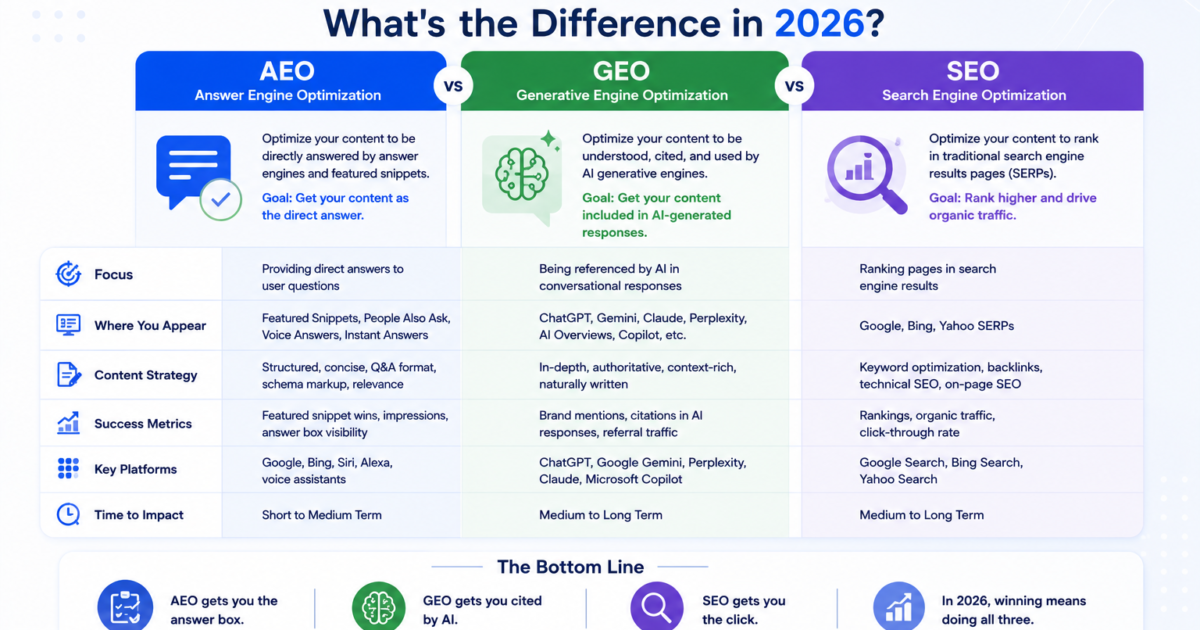
SEO is the practice of optimising a website to rank higher in traditional search engine results pages, primarily Google, with the goal of earning clicks from organic blue-link results.
SEO has existed since the late 1990s and remains the foundation everything else builds on. It covers technical factors (site speed, crawlability, mobile usability), on-page factors (keywords, headings, meta tags), and off-page factors (backlinks, domain authority).
Success metric: Click-through rate from the search results page. Primary platform: Google, Bing, and other traditional search engines.
What is AEO (Answer Engine Optimization)?
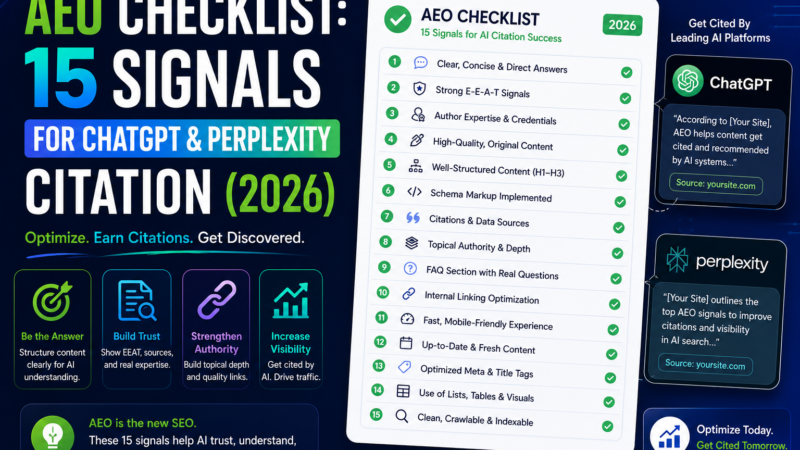
AEO is the practice of structuring content so that AI-powered answer engines like Google AI Overviews, ChatGPT, Perplexity, Bing Copilot, select it as a direct, cited answer to a user’s question, rather than just a ranked link.
AEO emerged as a distinct discipline as AI Overviews and conversational search interfaces became the first stop for many searches. The techniques differ meaningfully from classic SEO: question-based headings, FAQ schema, and direct-answer paragraphs matter more than backlink volume.
Success metric: Citation or featured selection in an AI-generated answer. Primary platform: Google AI Overviews, Perplexity, Bing Copilot, voice assistants.
Check your AEO score free at SEO Inspector Hub’s AEO checker.
What is GEO (Generative Engine Optimization)?
GEO is the practice of building entity authority and cross-web presence so that generative AI models like ChatGPT, Claude, Gemini — recommend or mention your brand unprompted, inside a conversation, without the user directly visiting your website at all.
This is the newest and least understood of the three. GEO does not depend on a user typing a query that matches your page. It depends on the AI model having learned, during training or retrieval, that your brand is a relevant, trustworthy answer to a category of questions. A user might ask ChatGPT “what’s a good free white label SEO tool” and get your brand mentioned by name, with no search query or click involved at all.
Success metric: Unprompted brand mentions inside AI-generated conversations. Primary platform: ChatGPT, Claude, Gemini, and other conversational AI models.
Check your GEO readiness free at SEO Inspector Hub’s GEO checker.
Want the full side-by-side breakdown of goals, platforms, and techniques for all three? See the comparison table on our AI Search Optimization guide.
How they overlap
These are not competing strategies, they share a technical foundation.
Good technical SEO is a prerequisite for both AEO and GEO. A page with broken Core Web Vitals, missing schema, or poor crawlability will struggle to be cited by an answer engine or recommended by a generative model, regardless of how well the content itself is written.
FAQ schema benefits all three. Structured Q&A data helps traditional SEO rich results, gives AI Overviews a clean answer to extract, and signals to generative models that your content is organised and trustworthy.
E-E-A-T (Experience, Expertise, Authoritativeness, Trustworthiness) is the connective tissue. Google’s quality framework affects classic rankings, but it has become equally important for AI citation and generative recommendation. Original data, verified author credentials, and consistent brand presence across the web move the needle on all three at once.
Which one should you prioritise first?
This depends entirely on what your Search Console data is telling you. Use this framework:
If you have high impressions but very low clicks — your problem is AEO. AI Overviews are likely answering the query before anyone reaches your site. Structuring content for direct citation is your fastest fix.
If you have low impressions across the board — your problem is SEO fundamentals. You are not appearing for enough queries in the first place. Fix technical SEO, build topical content, and earn backlinks before worrying about AEO or GEO.
If your brand is invisible in ChatGPT, Claude, or Gemini conversations about your category — your problem is GEO. This matters most for product and tool websites where being recommended in an AI conversation is now a real acquisition channel, separate from search entirely.
Most websites in 2026 need to work on all three simultaneously, but the order matters. Fix the floor (SEO) before building the roof (AEO and GEO).
How to check where you stand on all three – free
You do not need to guess which of the three is your weak point. Run all three free checks and compare:
- SEO health: Free SEO Audit Tool – 60+ point technical and on-page audit
- AEO readiness: AEO Checker – schema, heading structure, and direct-answer scoring
- GEO readiness: GEO Checker – entity authority and cross-web presence scoring
Running all three on the same page in under two minutes gives you a complete picture instead of optimising blind.
Frequently Asked Questions
What is the difference between AEO and SEO?
SEO optimises a website to rank in traditional search engine results and earn clicks from blue links. AEO optimises content to be selected as a direct, cited answer inside AI-powered tools like Google AI Overviews, ChatGPT, and Perplexity often without the user clicking through to the website at all. SEO and AEO share technical foundations but require different content structuring techniques to succeed.
What is the difference between AEO and GEO?
AEO focuses on getting content cited as a direct answer when a user asks an AI tool a specific question. GEO focuses on getting an AI model to recommend or mention a brand unprompted, during a broader conversation, based on the model’s learned understanding of which brands are trustworthy and relevant in a category. AEO is query-triggered; GEO can happen without any specific query matching your content at all.
Do I need to do SEO, AEO, and GEO all at once?
Most websites benefit from working on all three, but the right starting point depends on your current data. Sites with high impressions and low clicks should prioritise AEO. Sites with low impressions overall should prioritise foundational SEO. Sites with no presence in AI conversations about their category should prioritise GEO. Strong technical SEO underpins success in both AEO and GEO, so it should never be skipped entirely.
Is GEO the same as generative AI marketing?
No. GEO (Generative Engine Optimization) specifically refers to optimising a brand’s web presence and entity signals so that generative AI models cite or recommend it during conversations. Generative AI marketing is a broader term that can include using AI tools to create marketing content, which is a different and unrelated activity.
How do I check my AEO and GEO scores for free?
SEO Inspector Hub offers free checkers for both: the AEO checker analyses schema markup, heading structure, and direct-answer content quality, while the GEO checker evaluates entity authority and cross-web brand presence signals. Both tools require no signup and return results in seconds.
Will AEO and GEO replace traditional SEO?
No. Traditional SEO continues to drive a significant share of website traffic from users who search and click conventionally. AEO and GEO are additive disciplines that capture visibility and brand exposure in AI-driven search and conversation, which traditional SEO does not address. A complete 2026 strategy includes all three rather than replacing one with another.
Conclusion
SEO gets you found. AEO gets you cited. GEO gets you recommended. Three different outcomes, three different audiences, and in 2026, all three matter for any website serious about visibility.
The fastest way to know where to focus is to check all three scores for your own site today most websites are strong in one area and badly underdeveloped in another, and that gap is usually where the easiest wins are hiding.