
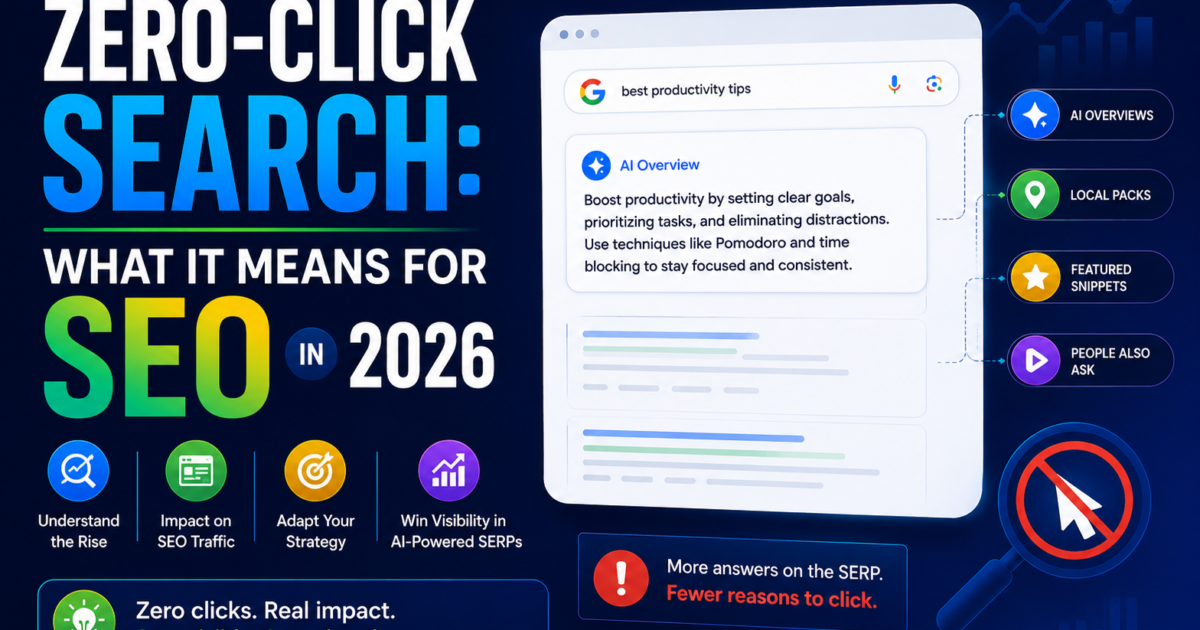
More than two out of every three Google searches now end without the user clicking anything. That’s not a rounding error or a temporary AI Overviews blip, it’s the culmination of a trend that’s been building since 2019 and just had its fastest two-year jump on record.
📖 This article is part of our complete guide to AI Search Optimization (AEO & GEO) – see it for the full framework and free checkers.
What is a zero-click search?
A zero-click search is any query where the user gets the answer they need directly on the search results page and never clicks through to a website. This includes answers delivered through featured snippets, knowledge panels, People Also Ask boxes, and increasingly, AI Overviews and AI Mode.
A search for “what year is the next leap year” or a currency conversion typed into Google are classic examples Google answers directly, and no website ever gets the visit, regardless of how well any individual site might be optimized for that query.
The actual numbers
Zero-click statistics vary by methodology and panel, so it’s worth citing the trend rather than treating any single number as fixed. Rand Fishkin’s SparkToro first quantified this using Datos clickstream data in 2019, when roughly half of Google searches ended without a click.
The most recent SparkToro and Similarweb study, covering US searches from January through April 2026, found that 68.01% of Google searches ended without a click and up from 60.45% in 2024. Framed as a ratio, only about 276 clicks now reach the open web for every 1,000 searches performed, down from 374 in the 2024 study.
The gap widens sharply when an AI Overview appears. Separate research from Pew Research Center found that users click through to a cited source only about 8% of the time when an AI Overview is shown, compared to roughly 15% when it isn’t meaning an AI Overview appearing on a query close to halves the odds of any click at all.
Why it’s accelerating
Two separate mechanisms are driving this, and it’s worth telling them apart because they call for different responses.
AI Overviews are the first mechanism. They now appear on roughly one in five Google searches and continue to expand. When present, they answer the query directly above all organic results, absorbing clicks that would otherwise have gone to a ranked page.
The second, less-discussed mechanism is behavioral. SparkToro’s research found that the share of searches leading to another Google search, rather than a click to any external site, rose meaningfully between 2024 and 2026. Google is increasingly successful at keeping users refining their query inside the search results rather than leaving the platform at all.
What still gets clicks
Not every query behaves the same way, and the split matters for where you focus effort.
Quick-answer queries go zero-click first. Definitions, unit conversions, sports scores, and simple facts get answered on the page itself, so the click was never going to happen regardless of content quality.
Navigational and branded searches – someone searching your exact business name, or “hours” plus a business often resolve with a phone number, address, or map result directly on the SERP.
Complex research, comparisons, and considered purchases still drive clicks. When people want to weigh options, read reviews, or dig into specifics an AI summary can’t fully resolve, they still click through. This is where most commercial SEO value still lives.
What this means for your SEO strategy
Zero-click doesn’t mean zero value, it means the value has moved from the click to the citation. If your brand or content is the one an AI Overview names and summarizes, you’ve still reached the person at the moment they were deciding, even without a visit to show for it in your analytics.
Practically, this means three things. First, keep investing in genuinely commercial, comparison, and research-heavy content, since that’s where clicks are holding up best. Second, structure content so it can be the one an AI Overview extracts and cites, even on queries where the click itself may never come and see our AI Search Optimization guide for the specific structural changes that help. Third, stop treating organic sessions as the only success metric.
How to measure success beyond clicks
Search Console still shows impressions even for zero-click queries, so impression volume and average position remain visible even when clicks don’t follow and track them as a visibility metric in their own right, not just a stepping stone to clicks.
Beyond that, watch whether your brand or content gets mentioned inside AI-generated answers at all, since that’s the citation-level value zero-click search shifts toward. Run your key pages through an AEO checker and GEO checker to see how likely they are to be the source an AI system pulls from, rather than relying on click-through rate alone to judge whether the content is working.
Frequently Asked Questions
Is zero-click search the same as AI Overviews?
No. Zero-click search is the broader category covering any query answered directly on the results page, including featured snippets and knowledge panels that predate AI Overviews by years. AI Overviews are one specific, rapidly growing contributor to the overall zero-click rate.
Does zero-click search mean SEO doesn’t matter anymore?
No. Commercial, comparison, and research-intent queries still drive substantial clicks, and being the cited source inside a zero-click answer still delivers brand visibility even without a visit. SEO’s job has expanded to include earning that citation, not disappeared.
Which industries are hit hardest by zero-click search?
Informational content like definitions, simple how-to facts, quick reference queries sees the highest zero-click rates. Transactional and product-focused queries, including most e-commerce searches, retain meaningfully more clicks since users typically need to compare or complete a purchase off-page.
How do I know if zero-click is affecting my site?
Check Search Console for pages with high impressions but low click-through rate relative to their position that pattern often indicates an AI Overview or featured snippet is answering the query before users reach your listing.
Conclusion
Zero-click search has gone from a curiosity to the default outcome of most Google searches. The response isn’t to abandon SEO, it’s to keep the click-driving work on commercial and research queries where clicks still happen, while building the structural and authority signals that earn a citation on everything else.