
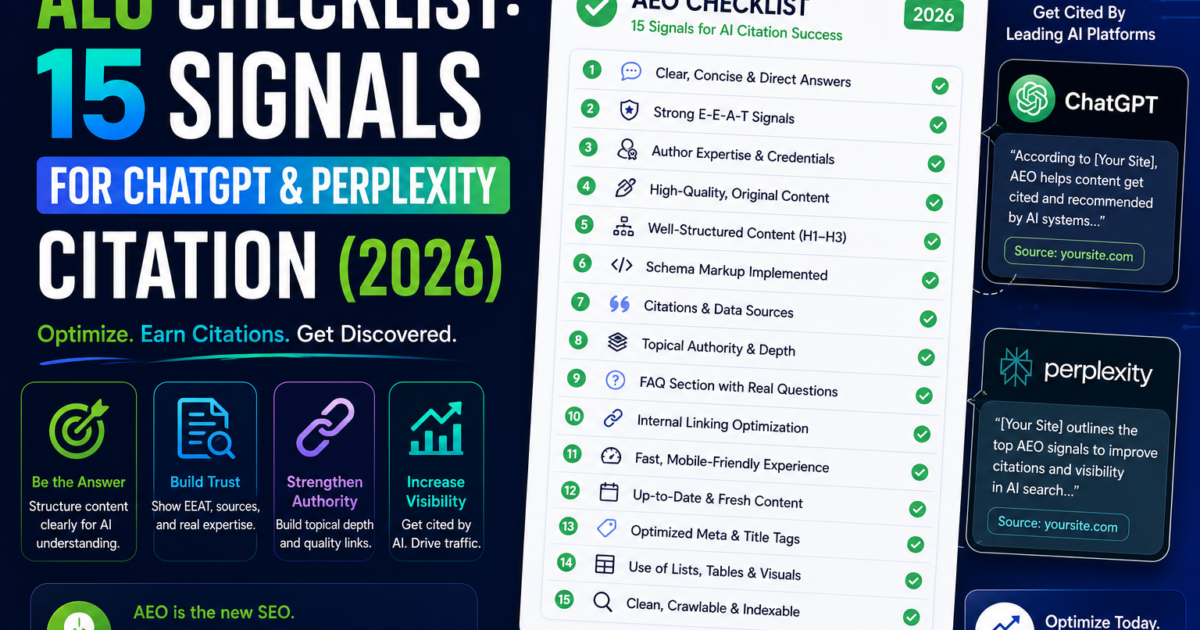
Getting cited by ChatGPT or Perplexity isn’t luck. It comes down to a specific set of technical and content signals most of which are checkable in minutes. This checklist covers all 15, grouped by category, so you can find your gaps instead of guessing.
This checklist is part of our complete guide to AI Search Optimization (AEO & GEO) – see it for the broader framework and free checkers.
Why a checklist instead of a single fix
There’s no single setting that gets a page cited by an AI model. Citation depends on a combination of whether the model’s crawler can access the page, whether the content is structured for extraction, whether the claims are specific enough to attribute confidently, and whether the source carries enough authority to trust. Missing any one category can quietly disqualify an otherwise strong page.
Access signals: can AI crawlers even reach you?
These come first because none of the content-level work matters if a crawler can’t reach the page.
1. robots.txt allows the relevant AI crawlers. Check specifically for GPTBot (OpenAI), ClaudeBot (Anthropic), PerplexityBot, and Google-Extended. A blanket disallow rule written for a different purpose can silently block all of them.
2. No aggressive JavaScript-gating on core content. If your main content only renders after heavy client-side JavaScript execution, some crawlers may index an incomplete version of the page.
3. Page returns a clean 200 status with no redirect chains. Long redirect chains or intermittent errors reduce the odds a crawler successfully indexes the page at all.
Structure signals
4. FAQPage schema on genuine Q&A content. This is the single clearest structural signal you can give a model it explicitly marks a question and its answer as a discrete, extractable unit.
5. Question-format H2/H3 headings. Headings phrased as real questions (“What is X,” “How does Y work”) map directly onto how users phrase prompts to AI models.
6. The answer appears within the first 2-3 sentences under each heading. Models extracting an answer favor content that doesn’t require reading five paragraphs to find the point.
7. Clear document hierarchy (H1 → H2 → H3, no skipped levels). A clean heading hierarchy helps a model understand which sections are subordinate to which topics.
Content signals
8. Specific, attributable claims – not vague generalities. “Sites with FAQ schema saw increased snippet eligibility in a 2025 study” is attributable. “FAQ schema helps a lot” is not.
9. Named entities used explicitly, not pronouns. Repeating your brand, product, or concept name instead of “it” or “this tool” gives a model a much clearer anchor for attribution.
10. Original data or first-hand experience somewhere on the page. Content that only restates what’s already widely published gives a model no reason to prefer your source over any other saying the same thing.
11. Balanced coverage – pros, cons, and alternatives, not just a sales pitch. Models trained to be helpful tend to favor sources that present a fuller picture over ones that read as one-sided marketing.
Authority signals
12. Visible author identity with real credentials. An author byline linking to a bio page with actual experience signals is a trust marker both for human readers and for models weighing source credibility.
13. Consistent entity presence across the web. If your brand and author show up consistently across your own site, social profiles, and third-party mentions, that consistency reinforces which entity is actually being discussed.
14. Inbound citations from other credible sources. Being referenced by other sites remains a strong authority signal for AI models, similar to backlinks in traditional SEO, though the mechanism isn’t identical.
Freshness signals
15. A visible, accurate last-updated date. For any topic where facts change pricing, statistics, tool comparisons a stale, undated page is a weaker citation candidate than a recently reviewed one, even if the underlying content hasn’t changed much.
How to run this checklist in under 5 minutes
Rather than manually checking all 15 points, run the page through a structured scan:
- AEO readiness: AEO Checker – covers structure and schema signals (items 4-7)
- GEO readiness: GEO Checker – covers authority and entity signals (items 12-14)
- Technical foundation: Free SEO Audit Tool – covers access and crawlability (items 1-3)
For the full framework tying access, structure, content, authority, and freshness together, see our AI Search Optimization guide.
Frequently Asked Questions
Do I need all 15 signals to get cited?
No single signal is strictly required, but each missing signal reduces your odds. Pages that score well across most categories — access, structure, content, authority, and freshness – see meaningfully better citation rates than pages strong in only one area.
How is this different from normal SEO?
Traditional SEO signals like backlinks and keyword targeting still matter, but AI citation adds specific requirements around crawler access for AI-specific bots, structured Q&A formatting, and attributable, specific claims that a model can confidently reuse.
Can I block specific AI crawlers while allowing others?
Yes. Each major AI crawler like GPTBot, ClaudeBot, PerplexityBot, Google-Extended can be allowed or disallowed individually in robots.txt, letting you choose which AI systems can access and potentially cite your content.
Does page speed affect AI citation?
Page speed itself isn’t a direct citation signal, but poor Core Web Vitals often correlate with technical issues, like blocked resources or incomplete rendering, that can prevent a crawler from accessing content cleanly in the first place.
Conclusion
AI citation isn’t random, it’s the compounding effect of access, structure, content quality, authority, and freshness signals working together. Most sites are strong in one or two categories and weak in the rest. Run the checklist, find your weakest category, and fix that first.