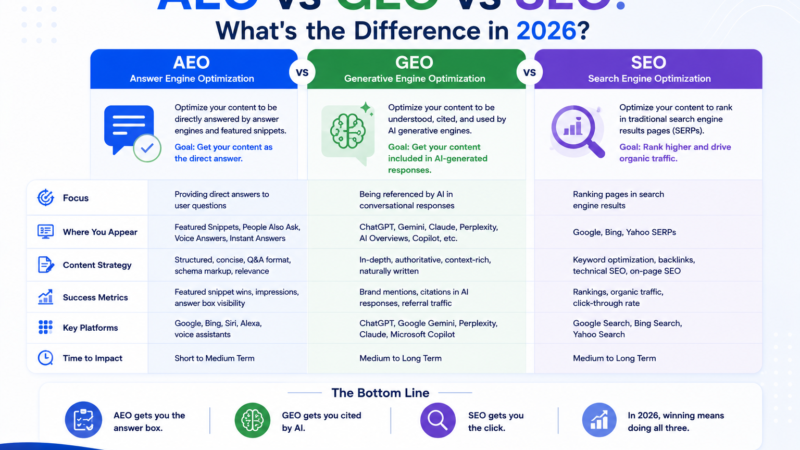

Google AI Mode and AI Overviews now answer a large share of searches before anyone reaches a website. If your content isn’t structured for that, you’re invisible for those queries no matter how well you’d normally rank.
This guide covers the specific, testable changes you can make to a page today to improve how AI Mode and AI Overviews interpret and cite your content not vague advice about “writing quality content,” but the actual structural signals these systems respond to.
📖 This article is part of our complete guide to AI Search Optimization (AEO & GEO) see it for the full framework and free checkers.
What is Google AI Mode?
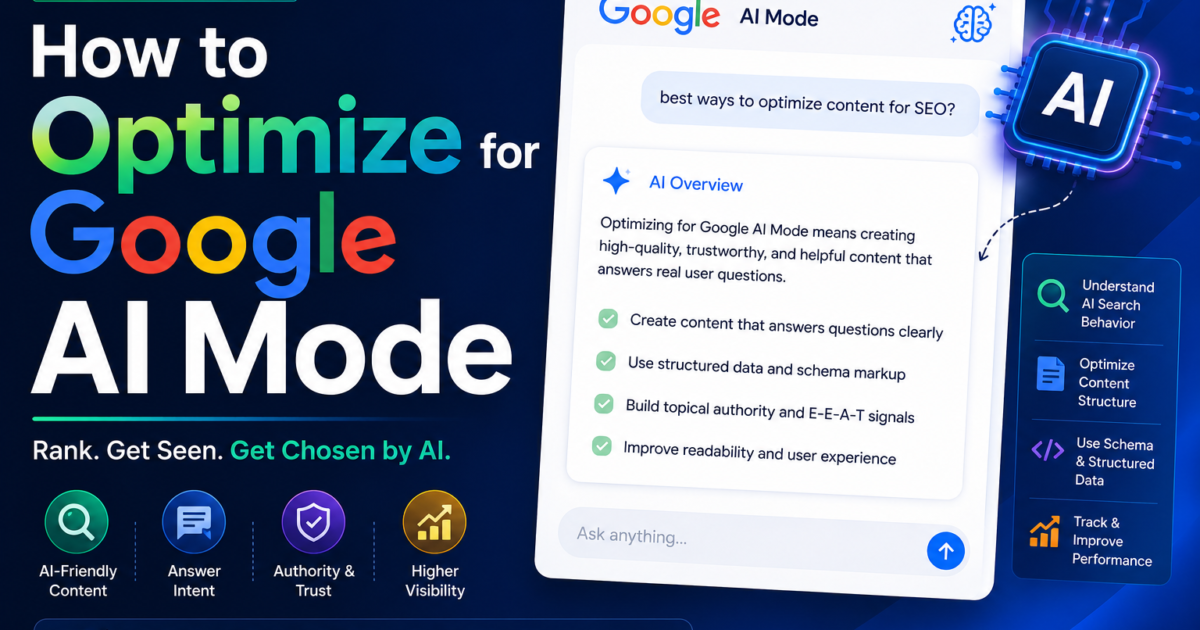
Google AI Mode is a conversational search experience that generates a synthesized answer using multiple sources, lets users ask follow-up questions in the same thread, and often shows no traditional blue-link results at all for the initial query.
Unlike a standard search results page, AI Mode treats the interaction as an ongoing conversation. It pulls from several pages to construct one answer, and it can reformulate the user’s question behind the scenes before retrieving results — meaning the query that actually triggers your page being pulled in often isn’t the one the user typed.
How AI Mode differs from AI Overviews
These two are often confused because they look similar, but they behave differently and reward slightly different things.
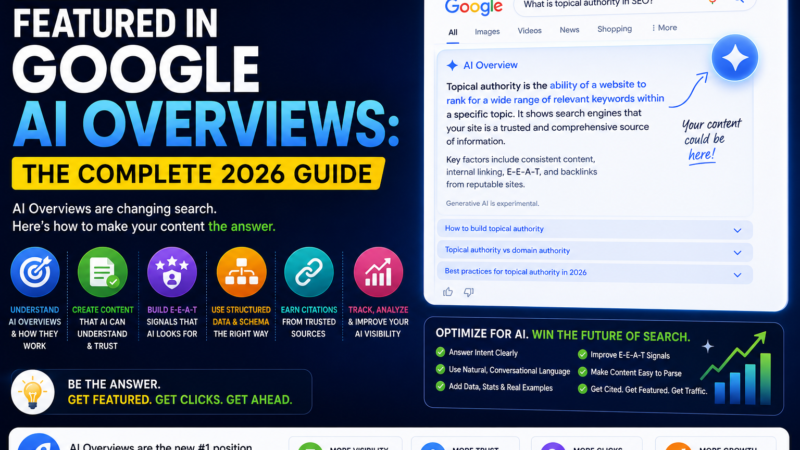
AI Overviews appear above traditional results on a standard search results page, for a single query, and typically cite 3-8 sources in expandable links. They favor pages with a clear, extractable answer near the top of the content.
AI Mode is a separate, full-page conversational experience. It synthesizes across more sources, sustains context across follow-up questions, and rewards pages that go deeper on a topic rather than just answering one question well because a follow-up question might pull from the same page again.
Practical takeaway: optimize your intro paragraph and headings for AI Overviews (single, extractable answers), and optimize your overall topic depth and internal structure for AI Mode (comprehensive coverage a follow-up question could still pull from).
Why your content might be getting skipped
Before changing anything, it helps to know what actually disqualifies a page. The most common reasons content gets skipped by AI Mode and AI Overviews:
The answer is buried. If a user’s question isn’t answered in the first 2-3 sentences after a heading, the system has to work harder to extract it and often skips the page in favor of one that answers faster.
The page lacks structural signals. No FAQ schema, no clear question-style headings, no HowTo or Article markup, these make it harder for the system to identify what type of answer your content offers.
The content isn’t crawlable in the first place. If your robots.txt blocks Google-Extended or your page has thin technical SEO, none of the content-level fixes below will matter.
The claims aren’t specific enough. Vague, generic statements are harder for a generative system to confidently attribute and cite than specific, concrete claims with numbers or named entities attached.
7 changes that improve your odds of being cited
1. Answer the question in the first two sentences under every heading. Don’t build up to the answer, state it directly, then explain. This is the single highest-impact change most pages can make.
2. Use question-format headings that mirror real search queries. “What is X” and “How to do Y” headings map directly to how these systems parse intent, more reliably than clever or branded headings.
3. Add FAQPage schema to any page with genuine Q&A content. This gives the system structured data it can extract with confidence, rather than having to infer structure from prose.
4. Use specific numbers, names, and dates instead of vague claims. “Most websites see improvement” is weak. “Sites that added FAQ schema in a 2025 Search Engine Journal study saw featured snippet gains” is a claim a model can confidently attribute always cite where a stat actually comes from.
5. Keep paragraphs short – 2 to 4 sentences. Long, unstructured blocks of text are harder to extract cleanly. Short paragraphs with one idea each are easier for both AI Overviews and human skimmers.
6. Build topic depth, not just single-answer pages. AI Mode rewards pages that can answer a follow-up question, not just the original one. Cover the “why,” the exceptions, and the edge cases, not just the core definition.
7. Confirm your robots.txt allows the relevant AI crawlers. If you want to be eligible for citation in Google’s AI systems, Google-Extended and Googlebot must be able to access your content. Check this before doing any content work, it’s a hard blocker if wrong.
What not to do
Don’t keyword-stuff question headings. Cramming exact-match queries into every heading reads as manipulative to both users and increasingly sophisticated ranking systems.
Don’t fabricate statistics to seem more “citable.” If a model or a human fact-checks a fabricated number back to your site, it damages trust permanently. Only cite data you can stand behind.
Don’t sacrifice readability for structure. FAQ blocks and short paragraphs should still read naturally. A page that feels like a checklist dumped onto a template reads poorly to actual visitors, even if it scores well on structure.
How to check your current readiness
Rather than guessing which of the seven changes above your page is missing, run it through a structured check:
- AEO readiness: AEO Checker scores schema, heading structure, and direct-answer formatting
- GEO readiness: GEO Checker scores entity clarity and citation-readiness
- Technical foundation: Free SEO Audit Tool confirms crawlability isn’t blocking everything else
For the complete framework tying all three together, see our AI Search Optimization guide.
Frequently Asked Questions
Does AI Mode use different ranking factors than normal search?
AI Mode builds on the same underlying index and core ranking signals as traditional Google Search, but it adds a synthesis layer that favors pages with clear, extractable answers and sufficient topic depth to support follow-up questions in the same conversation.
Will optimizing for AI Overviews hurt my regular SEO?
No. The changes that help AI Overviews – clear answers, FAQ schema, specific claims, short paragraphs align with existing SEO best practices and generally improve traditional rankings and featured snippet eligibility at the same time.
How long does it take to see results from these changes?
There’s no fixed timeline since it depends on crawl frequency and existing domain trust, but structural changes like adding FAQ schema or restructuring headings are typically picked up within a few weeks on actively crawled pages.
Can I block my content from AI Overviews if I don’t want to be included?
Yes. Google provides specific meta tags and robots directives to opt out of AI Overviews inclusion while still appearing in standard search results, though most sites benefit from inclusion rather than opting out.
Conclusion
AI Mode and AI Overviews aren’t going away, and the pages getting cited aren’t necessarily the ones with the best writing, they’re the ones structured so a machine can confidently extract and attribute an answer. Lead with the answer, back it with FAQ schema, use specific claims, and confirm your technical foundation isn’t blocking access in the first place.