

Introduction
ChatGPT now handles around 800 million weekly active users. Perplexity processes over 100 million queries every day. Google AI Overviews appear on roughly 48% of all searches. And critically, users who get a recommendation from an AI assistant act on it 74% of the time, according to Growth Memo research published in April 2026.
- Introduction
- What is LLM SEO?
- How LLMs actually decide what to cite
- What actually drives LLM citations – the research
- 1. Content depth and structure, not keyword density
- 2. Freshness is a citation eligibility requirement, not just a CTR signal
- 3. Structured data is cited significantly more often
- 4. Traditional SEO is still the foundation, not the ceiling
- 5. AI crawlers must be able to access your site
- 6. JavaScript rendering is an invisible LLM SEO failure
- Platform-specific differences: ChatGPT vs Perplexity vs Google AI Overviews
- The practical LLM SEO framework: what to do
- Step 1 — Audit your AI visibility baseline
- Step 2 — Fix technical accessibility first
- Step 3 — Rewrite your content structure for passage extraction
- Step 4 — Add statistics and source citations to every substantive claim
- Step 5 — Add FAQ schema to every informational page
- Step 6 — Build cross-web brand presence systematically
- Step 7 — Update content regularly and timestamp it visibly
- How to track LLM SEO performance
- The most common LLM SEO mistakes
- Frequently Asked Questions
- Conclusion
This is the environment where LLM SEO matters. Not as a replacement for traditional search optimization, but as a separate, parallel discipline with different mechanics, different success metrics, and different winners.
The core insight that makes LLM SEO genuinely different from everything that came before it: SEO optimizes the page. LLM optimization optimizes the passage. A page can rank first on Google and still be invisible to AI if it doesn’t contain extractable, self-contained answer blocks. And a page at position 50 can be heavily cited by AI if it provides the best structured answer to a specific question.
That asymmetry is the opportunity. This guide covers what LLM SEO actually is, how the citation mechanism works at a technical level, what the research says about the factors that drive citations, and the specific actions that move the needle across ChatGPT, Perplexity, and Google AI Overviews.
What is LLM SEO?
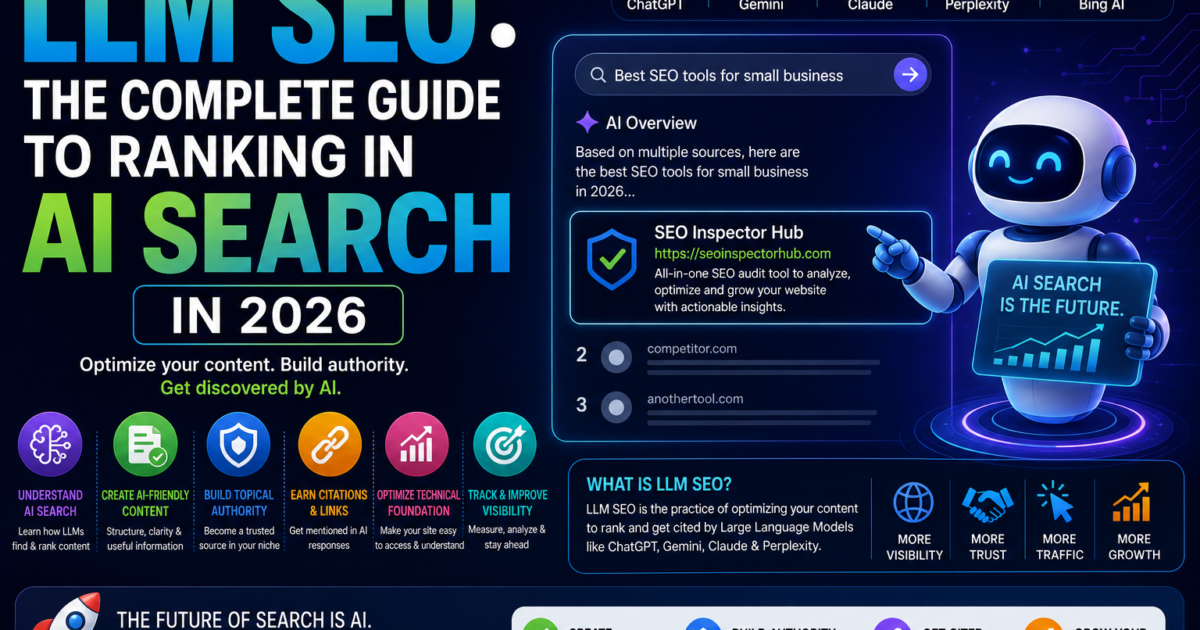
LLM SEO (Large Language Model Search Engine Optimization) is the practice of optimizing your content, technical infrastructure, and brand authority so that AI-powered tools like ChatGPT, Claude, Gemini, Perplexity, and Google AI Overviews that find, understand, and cite your content when generating answers.
Traditional SEO optimizes for algorithms that match queries to documents based on signals like backlinks, keywords, and user engagement metrics. LLM SEO optimizes for systems that interpret meaning, evaluate source credibility across their entire training corpus, and select content based on depth, originality, and clarity. The two share technical foundations like crawlability and heading structure but diverge on ranking mechanics, measurement, and content strategy.
The terminology gets messy in 2026. LLM SEO, GEO (Generative Engine Optimization), AEO (Answer Engine Optimization), AI SEO, and LLMO are all used across the industry, sometimes interchangeably, sometimes to describe slightly different things. For clarity, here’s how we use them on this site:
| Term | What it focuses on |
|---|---|
| LLM SEO | The umbrella discipline — getting cited by AI-powered tools broadly |
| AEO | Specifically structuring content to be selected as a direct cited answer |
| GEO | Building entity authority so AI models recommend your brand unprompted |
For the specific mechanics of AEO, our complete AEO guide covers that. For the entity authority side of GEO, our GEO guide has the full research. This post covers the broader LLM citation system, what makes any of it work at a fundamental level.
How LLMs actually decide what to cite
Before optimizing for citation, it helps to understand what’s actually happening when an AI tool generates an answer. The mechanism differs from traditional search in ways that matter for your strategy.
The two pathways to citation
LLMs don’t “browse the internet” the way a human does when they use Google. They generate responses based on two distinct mechanisms.
Pathway 1 – Training data (parametric memory). During initial training, the model absorbed vast datasets of web content, books, research, and publications. This creates long-term brand familiarity. If your brand has been consistently mentioned across authoritative sources over time, the model has effectively “learned” you and draws on that knowledge when answering relevant queries. This pathway dominates approximately 60% of ChatGPT queries.
Pathway 2 – Live retrieval (RAG). For queries requiring current information, the model searches the live web, retrieves the most relevant pages, and synthesizes that content into a response with citations. ChatGPT retrieves primarily via Bing. Perplexity uses its own crawler plus additional sources. Google AI Overviews pull from Google’s own index.
This distinction has a direct strategic implication: optimizing for training data influence (broad brand mentions, authoritative cross-web presence) is a long-term play. Optimizing for live retrieval (technical accessibility, structured content, strong underlying SEO) produces faster results and is where most actionable LLM SEO work happens in 2026.
How the retrieval process works
When a user asks a ChatGPT or Perplexity query that triggers live retrieval, the model doesn’t simply search for your exact keywords. When a user asks a long, conversational question, the LLM breaks it into shorter sub-queries behind the scenes and runs each one against live search results. Your content needs to rank for these shorter fragments not just the full-length query the user typed.
This “fan-out” process means keyword targeting for traditional search and topic coverage for LLM citation require different approaches. A page optimized for one exact-match keyword may miss the cluster of sub-queries the model generates for the same topic.
What actually drives LLM citations – the research
Enough practitioners have now published real data on this that opinion-based advice can largely be replaced with evidence. Here’s what the research says.
1. Content depth and structure, not keyword density
When it comes to securing AI mentions and citations, content depth (sentence and word counts) and readability matter most, while traditional SEO metrics like traffic and backlinks have little direct impact.
Content with statistics and citations gets 30–40% higher visibility in AI responses. Every claim needs a named source, a specific number, and a year. “Companies see significant improvement” is invisible to AI. “Companies see 4.4x conversion rates (Semrush, 2026)” is citable.
The content format that performs best is not surprising given this: Q&A is the best format for AI search. Structured content (headings and lists) is almost as effective for non-question queries, while dense paragraphs perform worst.
2. Freshness is a citation eligibility requirement, not just a CTR signal
85% of AI Overview citations were published in the last two years. 44% are from 2025. 50% of Perplexity citations are content published in 2025 alone.
In LLM optimization, 40–60% of citations change monthly. Pages updated within 2 months earn 28% more citations. Freshness signals “Last Updated” timestamps, current-year references, recent statistics aren’t just CTR boosters. They’re citation eligibility requirements.
3. Structured data is cited significantly more often
Pages cited by ChatGPT include structured data 71% of the time. The most relevant schemas: FAQPage even though Google retired the FAQ rich result in May 2026, FAQPage schema remains valuable because LLMs read structured data when indexing pages independently of how Google renders it in results.
4. Traditional SEO is still the foundation, not the ceiling
According to Kevin Indig, pages in Google’s top 10 show a strong correlation (~0.65) with LLM mentions, and 76% of AI Overview citations pull from these positions.</cite>
However and this is the meaningful caveat only 12% of URLs cited by ChatGPT rank in Google’s top ten results. This striking finding reveals a fundamental truth: traditional SEO success does not automatically translate to ChatGPT visibility.
The implication: strong traditional SEO is necessary but no longer sufficient. The overlap between “ranks well on Google” and “gets cited by ChatGPT” is real but far from complete.
5. AI crawlers must be able to access your site
This is the most commonly missed technical requirement in 2026 and one of the highest-impact fixes available. Kevin Indig discovered that Perplexity didn’t cite everydayhealth.com in its answers because the site blocked the LLM in its robots.txt.
Check your robots.txt right now for blocks on any of these crawlers:
GPTBot(ChatGPT)OAI-SearchBot(ChatGPT)PerplexityBot(Perplexity)Google-Extended(Google AI Overviews)ClaudeBot(Claude)
If any of these are disallowed, you are invisible to that platform regardless of how good your content is.
6. JavaScript rendering is an invisible LLM SEO failure
Most AI crawlers, including GPTBot, ClaudeBot, and PerplexityBot, do not execute JavaScript. If your critical content is rendered client-side, AI models cannot access it. This is one of the most common and most invisible LLM SEO failures.
If your site uses a JavaScript-heavy framework (React, Vue, Angular) without server-side rendering, a significant share of your content may be simply inaccessible to AI crawlers appearing perfectly to human visitors but returning blank or incomplete content to AI systems.
Platform-specific differences: ChatGPT vs Perplexity vs Google AI Overviews
Each major AI platform has different retrieval mechanics, different citation patterns, and different content preferences worth understanding separately.
| Factor | ChatGPT | Perplexity | Google AI Overviews |
|---|---|---|---|
| Live retrieval index | Bing | Own crawler + multiple sources | Google’s own index |
| Citation bias | Strong Bing ranking correlation | Rewards conversational structure | Google top-10 overlap highest |
| Most cited domains | Reddit, Wikipedia, Amazon, Forbes, Business Insider | Review sites, topical authorities | Wikipedia, YouTube, Google Blog, Reddit |
| Schema priority | FAQPage, Article, HowTo | FAQPage, HowTo | FAQPage, structured data broadly |
| Content format preference | Direct answers, entity-rich content | Parsed, structured, bullet-friendly | Featured snippet eligibility |
| Freshness sensitivity | High | Very high — 50% of citations from 2025 | High |
LinkedIn is the most-cited domain for professional queries in AI Overviews, AI Mode, ChatGPT, Microsoft Copilot, and Perplexity cited in 11% of AI responses. G2 is the most cited software review platform across ChatGPT, Perplexity, and Google AI Overviews.
For SEO tools specifically, this means your G2 listing and LinkedIn Company Page aren’t just directory presence they are direct citation sources that AI tools pull from when users ask about tools in your category.
The practical LLM SEO framework: what to do
Step 1 — Audit your AI visibility baseline
Before changing anything, run five to ten brand-relevant prompts across ChatGPT, Perplexity, and Google AI Overviews. Use queries your audience actually asks: “what’s a good free white label SEO audit tool,” “how do I check my AEO score,” “best free SEO checker for agencies.” Note whether you appear, where you appear, and which competitors appear instead.
This gap list is your LLM SEO backlog. Prioritise queries where competitors appear and you don’t, starting with the highest-intent terms.
You can run a free check of your AEO and GEO readiness two of the strongest LLM citation signals at SEO Inspector Hub.
Step 2 — Fix technical accessibility first
Before content or authority work, confirm AI crawlers can access your site. Check robots.txt, fix any JavaScript rendering issues on key content pages, and ensure your sitemap is submitted to both Google Search Console and Bing Webmaster Tools. Bing’s index powers multiple LLM platforms. Strong Bing performance increases your chances of appearing in Perplexity, Copilot, and other AI search results.
Most site owners submit to Google and forget Bing entirely. In the LLM era, Bing Webmaster Tools is directly relevant to ChatGPT and Perplexity citation in a way it hasn’t been for years.
Step 3 — Rewrite your content structure for passage extraction
The unit LLMs evaluate is a passage, not a page. Every section of your content needs to be able to stand alone a clear question in the heading, a direct answer in the first two sentences below it, supporting detail after. A reader (or AI crawler) should be able to extract any 40–60 word block from the page and get a complete, useful answer without reading what came before or after.
Dense, context-dependent paragraphs are the least-cited content format in AI responses. This is the most actionable single structural change most sites can make.
Step 4 — Add statistics and source citations to every substantive claim
Content depth and readability matter most for AI citations, while traditional SEO metrics like traffic and backlinks have little direct impact.
Replace vague claims with specific, sourced ones. “Many agencies struggle with client reporting” becomes “38% annual client churn at SEO agencies is primarily a reporting problem, not a delivery problem (ALM Corp, 2026).” The specific version is citable. The vague version is invisible.
Step 5 — Add FAQ schema to every informational page
Pages cited by ChatGPT include structured data 71% of the time.
Adding FAQ schema is a one-time, 20-minute task per page that directly improves your eligibility for citation across every major AI platform. Every informational page on your site should have a FAQ section at the bottom with FAQPage schema in JSON-LD format see our AEO guide for the exact implementation.
Step 6 — Build cross-web brand presence systematically
The top cited domains in ChatGPT in the US are Reddit, Wikipedia, Amazon, Forbes, and Business Insider. LinkedIn is cited in 11% of AI responses.
AI models pull citations from where they’ve learned to trust. Being mentioned not just linked to, but mentioned by name on Reddit, LinkedIn, G2, and industry comparison articles is how smaller sites appear in AI responses without needing enterprise-level domain authority. This is exactly why the directory submissions covered earlier in your content plan matter as LLM SEO, not just as link building.
Step 7 — Update content regularly and timestamp it visibly
Pages updated within 2 months earn 28% more citations.
Add a “Last updated: [Month Year]” timestamp to every blog post. Revisit and update your highest-traffic posts every 60–90 days, even if just to refresh statistics and check that all links still work. Freshness signals to AI systems that the source is actively maintained, which directly correlates with citation probability.
How to track LLM SEO performance
Traditional rank tracking doesn’t measure AI citations. You need a separate measurement layer.
| Tracking method | Cost | What it measures |
|---|---|---|
| Manual prompt testing | Free | Whether you appear in responses to specific queries |
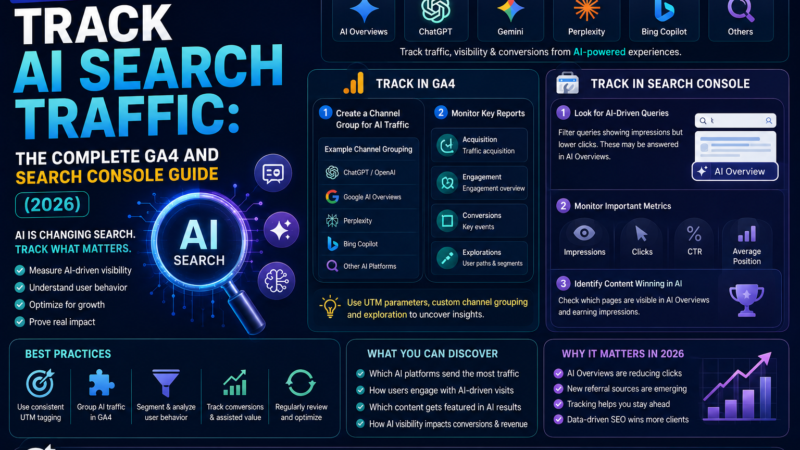
| GA4 AI referrer segments | Free | Sessions from ChatGPT, Perplexity, Gemini domains |
| Google Search Console AI Overviews filter | Free | AI Overview impressions and clicks |
| Otterly.AI | $29/month | Citation frequency and share of AI voice |
| Profound | $499+/month | Enterprise-grade cross-platform citation monitoring |
| Semrush AI Toolkit | Included in Semrush plans | Brand mention tracking in AI responses |
For most sites starting out, the free methods cover everything you need. Manual prompt testing five to ten queries weekly takes under 30 minutes and gives a clear enough picture of whether your work is moving the needle. Add GA4 segments for known AI platform referrers (chat.openai.com, perplexity.ai, gemini.google.com) to track which platform is actually sending you traffic.
The most common LLM SEO mistakes
Blocking AI crawlers in robots.txt. Astonishingly common sometimes from old security configurations, sometimes from aggressive scraper-blocking that accidentally catches GPTBot and PerplexityBot. Check this first.
Optimising for the full query instead of the sub-queries. LLMs break questions into fragments. Content that answers a specific narrow sub-question often outperforms content that tries to answer the broad question comprehensively.
Treating LLM SEO as separate from traditional SEO. 76% of AI-cited URLs rank in Google’s top 10. Foundation matters. LLM SEO is an additional layer, not an alternative strategy.
Making claims without sources. Unverified or vague assertions are invisible to AI citation systems. Every specific claim needs a named source, a specific number, and a year.
Ignoring Bing. ChatGPT and Perplexity both pull from Bing’s index as their primary live retrieval source. A site not submitted to Bing Webmaster Tools is starting from a disadvantage on both platforms.
Frequently Asked Questions
What is LLM SEO?
LLM SEO (Large Language Model Search Engine Optimization) is the practice of optimizing content, technical infrastructure, and brand authority so that AI tools like ChatGPT, Perplexity, Gemini, and Claude cite your content when generating answers. It differs from traditional SEO in that the goal is citation rather than ranking position, and the evaluation criteria focus on content clarity, factual depth, and structured extractability rather than keyword matching and backlink count.
Does LLM SEO replace traditional SEO?
No. Research consistently shows that 76% of AI-cited URLs rank in Google’s top 10 organic results, meaning traditional SEO is still the foundation AI citation builds on. However, only 12% of URLs cited by ChatGPT rank in Google’s top ten — which means traditional SEO success doesn’t guarantee AI visibility. Both strategies are needed and they share significant technical overlap.
How do I get my site cited in ChatGPT?
The highest-impact actions for ChatGPT citation are: ensure GPTBot and OAI-SearchBot are not blocked in your robots.txt, structure content with direct-answer passages under question-based headings, add FAQ schema to informational pages, include specific statistics with named sources and dates, submit your site to Bing Webmaster Tools (ChatGPT retrieves via Bing), and build brand mentions across Reddit, LinkedIn, G2, and industry comparison articles.
Is LLM SEO the same as GEO and AEO?
Related but distinct. LLM SEO is the broadest term, covering optimization for any large language model citation. GEO (Generative Engine Optimization) focuses specifically on building the brand entity authority that makes AI models recommend you unprompted. AEO (Answer Engine Optimization) focuses on structuring specific pages to be selected as direct cited answers to specific queries. In practice most successful strategies combine all three. See our AEO guide and GEO guide for the specifics on each.
How long does LLM SEO take to show results?
Faster than traditional SEO for some tactics, slower for others. Fixing technical access issues unblocking AI crawlers, fixing JavaScript rendering can show results in weeks as AI crawlers re-index your site. Structural content changes to add FAQ schema and direct-answer paragraphs tend to show citation improvement within 4–8 weeks. Building the brand entity authority required for unprompted AI recommendations is a 6–12 month compounding effort, similar to the timeline for building domain authority in traditional SEO.
How do I track whether I’m being cited by AI?
Start with free methods: manually test 5–10 brand-relevant prompts in ChatGPT, Perplexity, and Google AI Overviews weekly; add GA4 segments for traffic from AI platform domains; and use Google Search Console’s AI Overviews filter for Google citation data. For automated tracking across multiple platforms, paid tools like Otterly.AI (from $29/month) or Profound ($499+/month) monitor citation frequency and competitor mentions systematically.
Conclusion
LLM SEO in 2026 is not a future consideration. ChatGPT referral traffic grew 206% year-on-year according to Semrush’s 2026 data. AI-referred visitors convert at 4.4x the rate of traditional organic traffic. Users who receive an AI recommendation act on it 74% of the time.
The good news for smaller sites is that the barrier to AI citation is not domain authority. It’s content structure, technical accessibility, and factual credibility. A newer site that answers specific questions clearly, with sources, in accessible structured content, can outperform larger competitors in AI citation rates without needing thousands of backlinks first.
Start with what you can fix today: check your robots.txt for blocked AI crawlers, run your top five pages through an AEO check, and test your brand in ChatGPT and Perplexity to see where the gaps are.
Check your AEO and GEO readiness free →
Related guides: What is AEO? The Complete Guide · What is GEO? · AEO vs GEO vs SEO · Free SEO Audit Checklist · White Label SEO Reporting Guide
Related tools: AEO Checker · GEO Checker · Free SEO Audit Tool · Core Web Vitals Checker

![What is AEO (Answer Engine Optimization)? A Complete Guide [2026]](https://seoinspectorhub.com/blog/wp-content/uploads/2026/06/Answer-Engine-Optimization-800x450.png)