
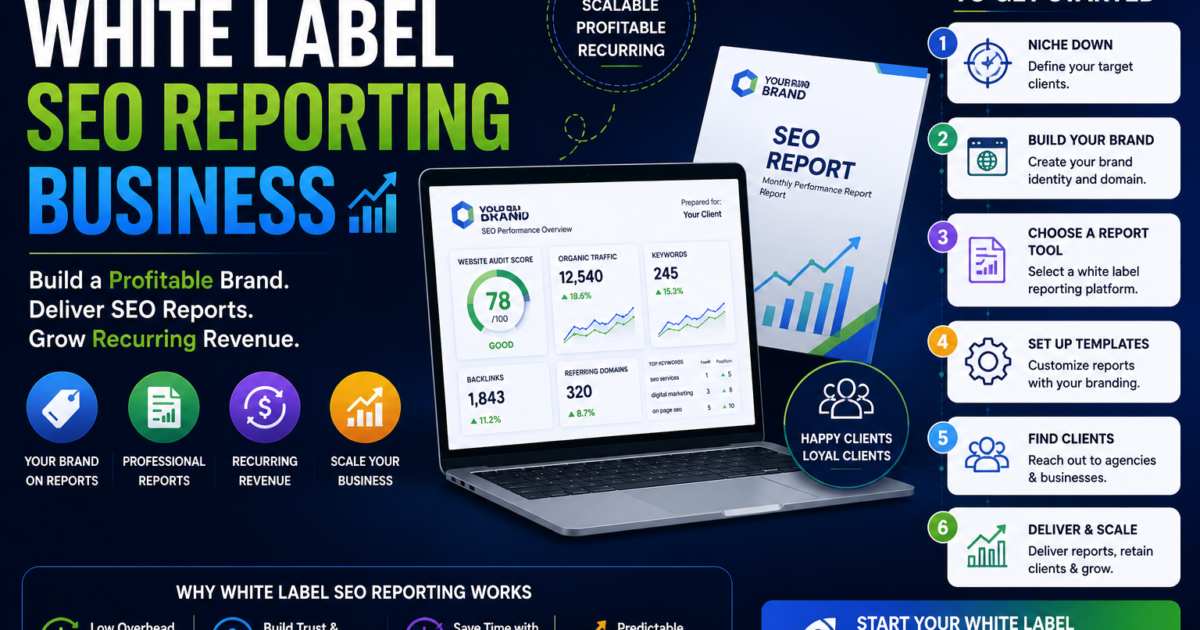
Reselling SEO services under your own brand is one of the lowest-overhead ways to add a recurring revenue line to an existing agency, freelance practice, or web design business. You don’t need to become an SEO expert overnight, you need a clear process, the right tools, and a way to present results that makes clients trust you enough to renew.
- What “white label SEO” actually means
- Step 1: Decide what you’re actually selling
- Step 2: Pick a niche before you pick clients
- Step 3: Choose your tool stack
- Step 4: Price it before you sell it
- Step 5: Land your first client
- Step 6: Send a report that earns the renewal
- Common mistakes to avoid
- Frequently Asked Questions
- Conclusion
This walks through the actual steps, not the theory, starting from picking a niche through sending your first client report.
📖 This article is part of our complete guide to white label SEO reporting – see it for the full toolset and free report generator.
What “white label SEO” actually means
White label SEO means reselling SEO services, tools, or reports under your own brand name, while some or all of the underlying work is done using a third-party platform or fulfillment partner the client never sees. The client only ever interacts with your brand like your logo, your report, your point of contact.
This differs from full in-house SEO delivery in one key way: you’re not necessarily building every capability yourself. You can white label the audit tool, the reporting, the link building, or all three, depending on how much you want to build versus outsource.
Step 1: Decide what you’re actually selling
Before anything else, get specific about scope. “SEO services” is too vague to price or deliver consistently. Pick a defined offer: monthly technical audits with a fix list, ongoing content and on-page optimization, local SEO management, or a combination but write it down as a specific, repeatable deliverable before you talk to a single client.
Step 2: Pick a niche before you pick clients
Generalist SEO resellers compete on price against everyone. Niche resellers like dentists, local law firms, e-commerce stores in one vertical, SaaS companies compete on relevance instead, and relevance lets you charge more and churn less, since the reporting and recommendations can speak directly to that industry’s actual concerns.
Step 3: Choose your tool stack
At minimum you need three capabilities: an audit tool to identify what’s wrong, a way to track rankings and visibility over time, and a way to generate client-facing reports under your own branding. You don’t need to build any of these from scratch – SEO Inspector Hub’s free SEO audit tool and white label report generator cover the audit and reporting layer without a subscription cost eating into thin early margins.
Step 4: Price it before you sell it
Most resellers under-price their first few clients out of nervousness, then struggle to raise prices on existing accounts later. Decide your pricing model upfront – flat monthly retainer is easiest to manage and easiest for clients to budget for, versus hourly or project-based, which creates more admin overhead for a solo operator.
Step 5: Land your first client
Your first client doesn’t need to come from cold outreach. Existing relationships, past freelance clients, referrals, or an existing web design/marketing client who’s never been offered SEO convert faster than strangers, because trust is already established. Offer a free audit as the entry point; a specific, professional-looking report (not a generic PDF) is often the deciding factor in whether that free audit converts to a paid retainer.
Step 6: Send a report that earns the renewal
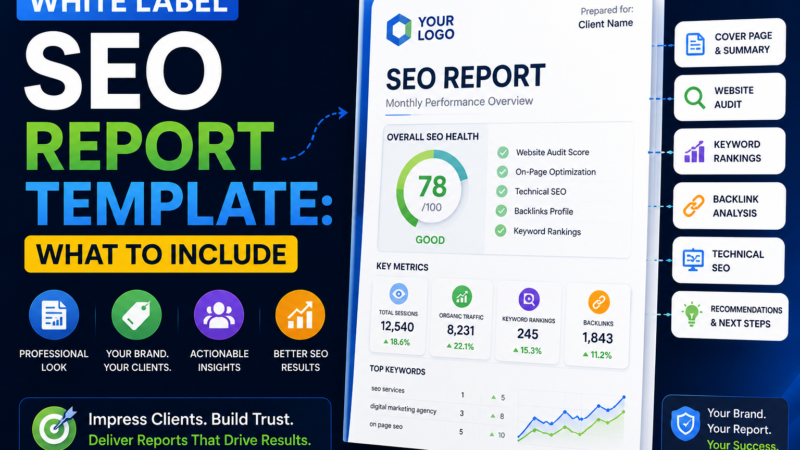
The report itself is where most new resellers lose clients they otherwise did good work for. A report that’s just a wall of ranking data doesn’t communicate value to a non-technical client. See our full breakdown in White Label SEO Report Template: What to Include for the exact section-by-section structure that keeps clients renewing.
Common mistakes to avoid
Promising rankings, not outcomes. “We’ll get you to page 1” is a promise you can’t fully control and that sets up a difficult conversation later. Frame commitments around process and effort instead audits completed, content published, technical issues fixed.
Underpricing to win the first few clients. This creates a ceiling that’s hard to raise later, since clients anchor to whatever they first paid.
Skipping the report structure entirely. Doing genuinely good SEO work but sending a confusing or data-dump report is one of the most common and most avoidable reasons resellers lose clients they should have kept.
Frequently Asked Questions
Do I need SEO experience to start a white label reporting business?
Some baseline understanding of SEO fundamentals helps you interpret results and answer client questions credibly, but you don’t need deep technical expertise to start, especially if you’re using audit and reporting tools that surface issues and explain them in plain language.
How much does it cost to start a white label SEO business?
Startup costs can be very low if you use free or low-cost audit and reporting tools rather than expensive enterprise SEO platforms, since the main investment early on is time rather than software spend.
Should I disclose to clients that I’m using a white label tool?
This is a business decision rather than a legal requirement in most cases. Many successful resellers don’t disclose the underlying tooling since the client relationship and accountability sit entirely with the reselling agency regardless of what’s used behind the scenes.
How many clients can one person realistically manage?
This depends heavily on scope per client and how much is automated versus manually done, but a solo operator focused on audits and reporting, rather than full-service execution, can typically manage more accounts than one doing hands-on link building or content production for every client.
Conclusion
Starting a white label SEO reporting business doesn’t require becoming an SEO expert on day one — it requires a defined offer, the right tools to identify and track issues, and a reporting process that makes your work visible to a non-technical client. Get those three right and the client relationships tend to take care of themselves.

![Free White Label SEO Audit Tools: Honest Comparison [2026]](https://seoinspectorhub.com/blog/wp-content/uploads/2026/06/Free-White-Label-SEO-Audit-Tools-800x450.png)